• Feeling isolated? You're not alone.

    Join 20,000+ people who understand exactly how your day went. Whether you're newly diagnosed, self-identified, or supporting someone you love – this is a space where you don't have to explain yourself.

    Join the Conversation → It's free, anonymous, and supportive.

    As a member, you'll get:

    • A community that actually gets it – no judgment, no explanations needed
    • Private forums for sensitive topics (hidden from search engines)
    • Real-time chat with others who share your experiences
    • Your own blog to document your journey

    You've found your people. Create your free account

An important lesson for the intrepid explorer.

Outdated

High Function ASD2
V.I.P Member
Never leave the marked trail.

Do not believe anything your phone tells you. Stick to the marked trail.

A couple of years ago a tourist disappeared in a remote part of north western Tasmania. She was young and fit and healthy, she was a seasoned traveller and an experienced hiker. Her car was found in the carpark of a trail heading to a waterfall but there was no other sign of her. The trail is only 1 Km long – just over half a mile, yet she got lost.

Her friends and family have come out to Australia a few times conducting their own searches and they finally had a breakthrough – they found her phone. They haven’t found her body yet but they’re beginning to piece together what must have happened.

screen04.webp


Her last known location was at the waterfall and the carpark was to the south west of her, but her phone was found 600 metres away to the north west, 90 degrees perpendicular to where she should have been heading.

What they now think has happened is that she checked her phone while she was at the waterfall, it was late in a winter’s afternoon, temperatures were below freezing and it was already getting dark.

And Google Maps showed her a shortcut.

That’s only a part of the problem though. Australia’s a huge country and sparsely populated so we don’t have mobile phone infrastructure everywhere. 85% of Australia’s land mass has no mobile phone coverage. Instead of wide coverage we have small hotspots here and there where they’re needed, and we install them in some tourist places too so that people can take a picture and send it to their friends. Walk too far away from that transponder and you have no mobile access.

So it’s looking like she started to follow a “shortcut” marked by Google Maps but the moment she moved away from the waterfall she lost access to Google Maps. It’s almost impossible to navigate in deep forests, constant dodging and weaving around trees and other obstacles makes you lose all sense of direction.

Tasmania Police to join renewed search for missing tourist Celine Cremer

Trust Aussies to always lay the easiest and quickest paths possible, we’re genuinely lazy bastards at heart and couldn’t imagine doing it any other way.
Never trust Google Maps.
 
If you want to use maps on your phone, use Organic Maps. Download the map data beforehand so you have them offline, and all you then need is a GPS signal. Mind you, in dense bush in hilly country that can be difficult, too, but at least you don’t need mobile access. (The app also has a feature that allows you to track your path on the outward journey and then follow the “breadcrumbs” home.)
 
This happens all the time in America too. The most notorious cases are people who get lost and stuck in our vast western deserts such as the legendary Death Valley. People die slowly from thirst and heat, they get delusional and start hallucinating which makes the situation that much worse. Sometimes their bones are found years later. Sometimes only their rusted cars turn up many years later. To the desert wildlife, a human body is food.
 
Never trust a phone, unless you know more than the phone does.

In addition to funky maps, there are a couple other apps that are deadly. One category that I know about for sure are "identify this fungus" apps.

The apps that identify plants and flowers work quite well, so a person might imagine the apps that identify mushrooms are OK as well.

They aren't. I've tested them myself. They can't be trusted even with common mushrooms. They frequently won't even get you to the correct genus.

Those apps are death traps waiting to kill.
 
Never trust a phone, unless you know more than the phone does.
It's not just your phone either, it's GPS as well.

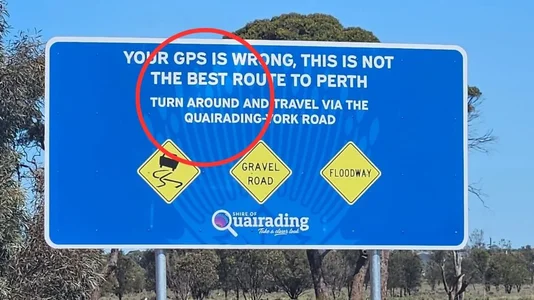
They say that they fix errors as soon as someone complains, but how much can you trust that when situations drag on for so may years that regional councils have to start installing proper signs?
 

Attachments

  • bac41cf2019817dcffff9f06b379905b.webp
    bac41cf2019817dcffff9f06b379905b.webp
    111.7 KB · Views: 6
It's not just your phone either, it's GPS as well.

They say that they fix errors as soon as someone complains, but how much can you trust that when situations drag on for so may years that regional councils have to start installing proper signs?
My automobile GPS is Looney tunes.

I drive down state fairly (too fairly) often. GPS always wants me to go weird places.

I did what it told me, once.

I drove down dirt roads for nearly an hour, and finally ended up at the highway I would otherwise have arrived at 40 minutes earlier.
 
It's not just your phone either, it's GPS as well.

They say that they fix errors as soon as someone complains, but how much can you trust that when situations drag on for so may years that regional councils have to start installing proper signs?
My mother lives a bit in the boonies. She always has to tell people to ignore their GPS for the last mile to her house and take the route she tells them. If they follow the GPS they will get stuck in loose "sugar sand".

I have reported the issue to Google several times, along with correct route info. They change the route for about a week, then change it back to the bad route. Even talking with a real person doesn't help. It keeps changing back.
 
Never leave the marked trail.

Do not believe anything your phone tells you. Stick to the marked trail.

A couple of years ago a tourist disappeared in a remote part of north western Tasmania. She was young and fit and healthy, she was a seasoned traveller and an experienced hiker. Her car was found in the carpark of a trail heading to a waterfall but there was no other sign of her. The trail is only 1 Km long – just over half a mile, yet she got lost.

Her friends and family have come out to Australia a few times conducting their own searches and they finally had a breakthrough – they found her phone. They haven’t found her body yet but they’re beginning to piece together what must have happened.

View attachment 147626

Her last known location was at the waterfall and the carpark was to the south west of her, but her phone was found 600 metres away to the north west, 90 degrees perpendicular to where she should have been heading.

What they now think has happened is that she checked her phone while she was at the waterfall, it was late in a winter’s afternoon, temperatures were below freezing and it was already getting dark.

And Google Maps showed her a shortcut.

That’s only a part of the problem though. Australia’s a huge country and sparsely populated so we don’t have mobile phone infrastructure everywhere. 85% of Australia’s land mass has no mobile phone coverage. Instead of wide coverage we have small hotspots here and there where they’re needed, and we install them in some tourist places too so that people can take a picture and send it to their friends. Walk too far away from that transponder and you have no mobile access.

So it’s looking like she started to follow a “shortcut” marked by Google Maps but the moment she moved away from the waterfall she lost access to Google Maps. It’s almost impossible to navigate in deep forests, constant dodging and weaving around trees and other obstacles makes you lose all sense of direction.

Tasmania Police to join renewed search for missing tourist Celine Cremer

Trust Aussies to always lay the easiest and quickest paths possible, we’re genuinely lazy bastards at heart and couldn’t imagine doing it any other way.
Never trust Google Maps.

She must have been very disoriented to lose or abandon her phone. She made numerous mistakes - leaving the marked trail, hiking alone, starting too late in the day to reach her destination and return before dark, not taking a hard copy map with her, and perhaps not taking adequate clothing, water and food. Have they ruled out foul play by some deranged psychopath who found her alone in the wilderness?
 
I leave the marked trail all the time in the summer and the shoulder seasons, just not in the winter when the cold and snow are danger multipliers. Of course, I know how to use a compass (I carry two) and I have printed maps and pencils with me. I also have a pack with a bivy shelter and survival supplies.

Life is more fun when you colour outside the lines.
 
Have they ruled out foul play by some deranged psychopath who found her alone in the wilderness?
There was never any suspicion of foul play in the first place. When they found her car it was obviously the only vehicle that had driven in there in weeks, hers were the only tracks.

That's the other part of Australia a lot of visitors don't realise, they don't just occasionally strike it lucky on a day when there's no people at these places. It would be extremely unusual to end up in these places on the same one or two days a year that it has any visitors.

The state of Texas has a bigger population than all of Australia which is the same size as mainland US.
 
There was never any suspicion of foul play in the first place. When they found her car it was obviously the only vehicle that had driven in there in weeks, hers were the only tracks.

That's the other part of Australia a lot of visitors don't realise, they don't just occasionally strike it lucky on a day when there's no people at these places. It would be extremely unusual to end up in these places on the same one or two days a year that it has any visitors.

The state of Texas has a bigger population than all of Australia which is the same size as mainland US.

She must have suffered a horrible, lonely death.
 
She must have suffered a horrible, lonely death.
It would have been hard indeed, best to think she succumbed to the cold first.

She certainly demonstrated the arrogance of the average instagrammer. Late in the afternoon, below freezing in an extremely remote place, "But I'll just quickly take a couple of pictures then dash back to the car.". Possibly also a little bit of arrogance simply because she was German and "used to cold weather".
 
It would have been hard indeed, best to think she succumbed to the cold first.

She certainly demonstrated the arrogance of the average instagrammer. Late in the afternoon, below freezing in an extremely remote place, "But I'll just quickly take a couple of pictures then dash back to the car.". Possibly also a little bit of arrogance simply because she was German and "used to cold weather".

Many people taking selfies die in the US every year, doing some dumb thing or the other like falling off the Grand Canyon cliffs, just to get a narcissistic picture of themselves.
 
Many people taking selfies die in the US every year, doing some dumb thing or the other like falling off the Grand Canyon cliffs, just to get a narcissistic picture of themselves.
Same here but normally they step backwards off a cliff or step in to a crocodile or something.

....they get delusional and start hallucinating.....
This happens before they get lost, in fact it's usually how they start getting lost in the first place. I've had heat stroke a few times myself including once in a similar situation to the people you mention. As your blood heats up it starts losing it's ability to carry oxygen, your brain starts suffering oxygen deprivation. You can no longer think straight, I got hopelessly lost in a small region of dense forest that I know like the back of my hand. It was only by accident that I stumbled on to a trail that I recognised after a couple of days.
 
So many of the SAR callouts are for people who get lost in familiar territory near home. They don't have a GPS beacon. They don't have extra power for phones. Extra clothes. Something to bivy in. You need to assume you can hit the rhubarb and be prepared for up to two nights waiting for rescue. Just because you can call for help on a phone or hit an SOS button it does not mean help comes right away.
 
It's not just your phone either, it's GPS as well.

They say that they fix errors as soon as someone complains, but how much can you trust that when situations drag on for so may years that regional councils have to start installing proper signs?
The State of California has installed a similar sign at the ghost town of Hilt, California, just south of the Oregon border. When the freeway was built, Hilt was a lumber town. A few years later, the lumber mill shut down and so did the town, but the exit remained. GPS keeps telling people stuck on Interstate 5 during snowstorms when Siskiyou Summit is closed to exit at Hilt and take Colestin Road. The problem is, Colestin Road was the original wagon road over the Siskiyou Passes, and after the railroad went in it was abandoned. So it's still a narrow, dirt road that isn't plowed in winter. People try it in winter, get stuck, and die. I think I have a pic of the sign somewhere.

Edit: bingo.

hilt.webp
 
Last edited:
Am I only one who finds it disturbing that two pictures of the research party shows people smiling so wide that it looks like they are having the time of their lives?

Hmm... The article says both rainfall and near-zero temperature, which a bad combination. More freezing would be better because it would mean both dry air and dry snow. If she also had a "winter" clothing that is more aesthetic than practical (typical to city-folk), she would be soaking wet and could be experiencing hypothermia with a fuzzy, disoriented head in more or less than an hour (I don't remember exactly what they taught about weather conditions, but I would assume this as based on my own experiences of bad clothing choices and weather assessments).

My phone's GPS claims that I am currently sitting at the playground of the neighboring apartment building (about 20 meter error) and facing a direction that is more than 90 degrees off from my real heading...

Possibly also a little bit of arrogance simply because she was German and "used to cold weather".
Belgian, which is even more towards the south. As a person who actually lives in an arctic country I would find that comment a little bit... laughable 🙂
 
Last edited:
Top Bottom