Gary DuBois
Well-Known Member
Both of those storys are good because they were able to escape and get to safety and no one got hurt =)

Feeling isolated? You're not alone.
Join 20,000+ people who understand exactly how your day went. Whether you're newly diagnosed, self-identified, or supporting someone you love – this is a space where you don't have to explain yourself.
Join the Conversation → It's free, anonymous, and supportive.
As a member, you'll get:
You've found your people. Create your free account
Both of those storys are good because they were able to escape and get to safety and no one got hurt =)
Here is a very similar one,Nicole Frýbortová competes for Slovakia in the World Championships of Kunstrad, or Artistic Cycling, a competitive sport popular in Germany and other parts of Europe where people perform amazing bike tricks, it has been described as ballet on fixed gear bikes.
[Youtube video removed.]
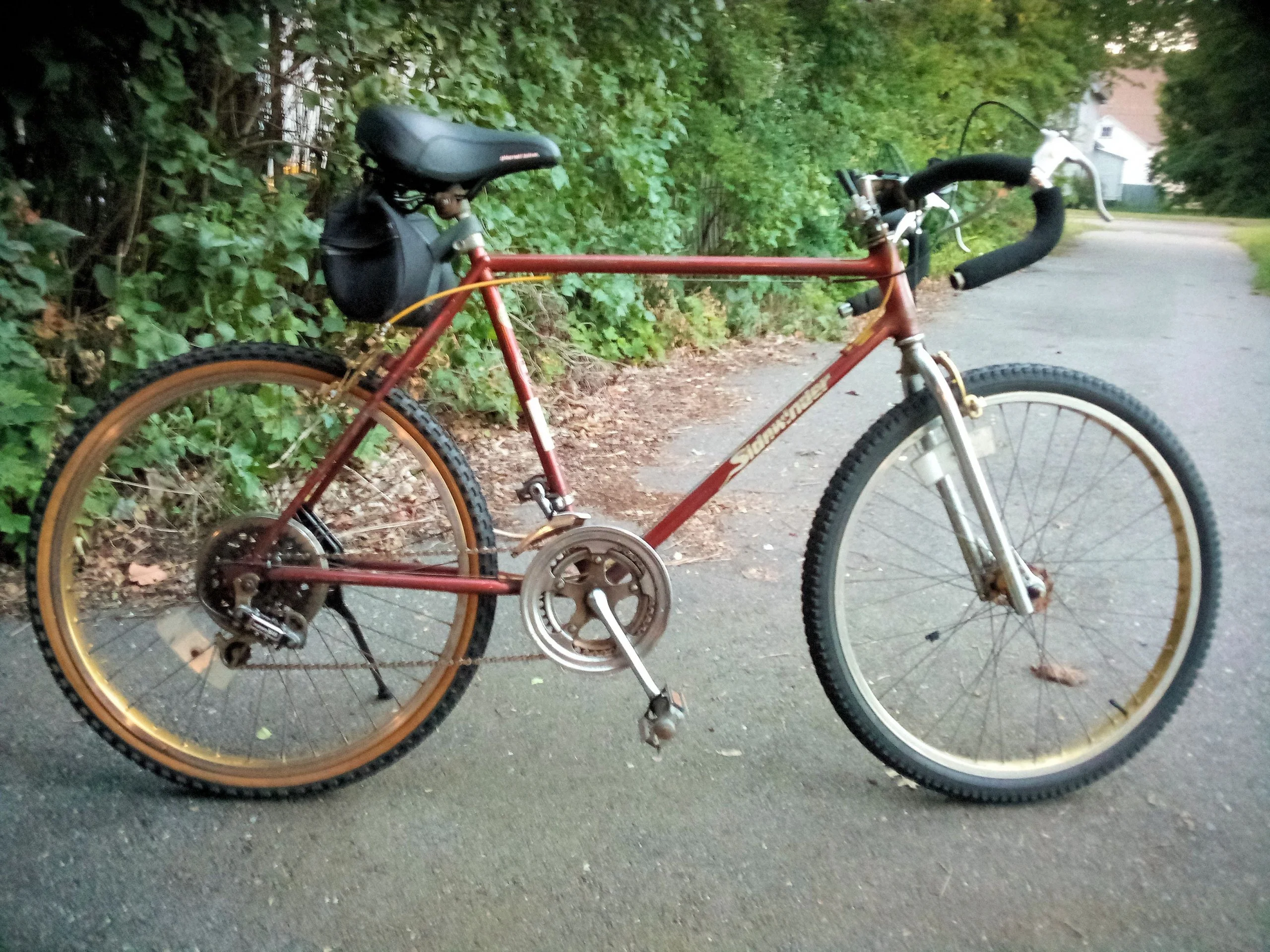
I finally uploaded a photo. I found out the modern term is "gravel" bike.Touring bikes were pretty much the standard department store ten-speeds of the 1970s. They aren't as fragile as racing bikes, but they are still pretty fragile and take about 70psi in their tires. I once hit a pothole that dented my front rim. As soon as that dent got to my brakes, it shot my brake pads forward and I came to a very abrupt stop. (Fortunately, I didn't go over the bars!)
Mountain bikes are made for rough terrain, but their handle bars & seat are designed for more BMX-style activities, not distance touring. (I am not that radical of a rider.) The touring seat & handle bars supported a more comfortable posture for touring, while the mountain bike frame proved to be more rugged. It is a little heavier to carry, but it isn't that noticeable when riding.
"Mixed terrain" wasn't a phrase back then, so I referred to this mountain bike with drop-bars as an argali-style mountain bike. (An argali is a very tall mountain sheep. Its drop-bars reminded me of their curved horns.)