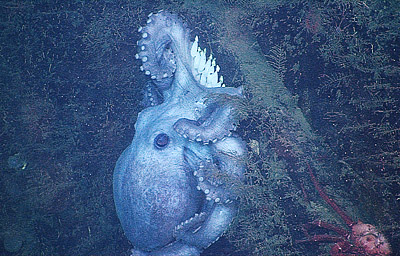
The ultimate goal of all species on the planet is procreation, the act of making anew. And many species go to great lengths to set their progeny off on the right path: orangutan mothers have been known to breast feed for eight years, the father emperor penguin braves the brutal Antarctic winter to warm a single egg, while the mother wolf spider carries her dozens of offspring wherever she goes. However, few could contend with a deep-sea octopus, known as
Graneledone boreopacifica, which researchers have recently observed guarding its eggs for four-and-a-half years (53 months), before likely succumbing to starvation soon after.
“At 53 months, it is by far the longest egg-brooding period ever reported for any animal species,” the researchers write in a paper on the discovery published today in the open-access journal PLOS ONE.
In March 2007, the marine biologists, headed by Bruce Robison from the Monterey Bay Aquarium Research Institute, used a remotely-operated vehicle to visit a deep sea site in the Monterey Submarine Canyon off of central California. At 1,397 meters (4,583 feet) deep they came on a female
Graneledone boreopacifica protecting a brood of its eggs. A month earlier, when the ROV had visited the same site, the octopus hadn’t been there.
“Given this singular opportunity to measure the length of a brooding period from its inception, we returned to the site 18 times over the ensuing four-and-a-half years,” the scientists write. “Each time we returned we found the same octopus clinging to the vertical rock face, arms curled, covering her eggs. Continuous growth of the eggs provided evidence that it was the same clutch throughout.”
Graneledone boreopacifica mother guarding her eggs. Photo by: 2007 MBARI
The female octopus was also easily identifiable by her tell-tale scars. After 53 months–in the Autumn of 2011–the eggs hatched. When the scientists visited the last time the eggs were empty and the mother was gone, presumably perished.
Many octopus mothers, such as the giant Pacific octopus (
Enteroctopus dofleini), are known to lay eggs only once in their lives. They guard and care diligently for the eggs, all the while losing weight and weakening due to a lack of food. They also change color, usually taking on a ghostly pallor. The mothers often die soon after the eggs hatch, essentially sacrificing themselves for the success of their children. The researchers believe
Graneledone boreopacifica acts similarly.
The world’s best mother: meet the octopus that guards its eggs for over four years