• Feeling isolated? You're not alone.

    Join 20,000+ people who understand exactly how your day went. Whether you're newly diagnosed, self-identified, or supporting someone you love – this is a space where you don't have to explain yourself.

    Join the Conversation → It's free, anonymous, and supportive.

    As a member, you'll get:

    • A community that actually gets it – no judgment, no explanations needed
    • Private forums for sensitive topics (hidden from search engines)
    • Real-time chat with others who share your experiences
    • Your own blog to document your journey

    You've found your people. Create your free account

Animal Facts that are surprising/amazing/weird

A publican from south-west Queensland has tragically died in a car accident. The Yaraka Hotel made headlines some years ago when the publican banned emus “for bad behaviour.”
IMG_0225.webp

IMG_0226.webp

The emus are known to target tourists, stealing food, drinks, car keys and generally making a mess. Their toileting [inside] was not particularly pleasant.
 
1760278626310.webp


Tiny Frogs and Tarantulas: An Unexpected Friendship | Articles | Science Victoria | Royal Society of Victoria
"You may have heard of iconic mutualistic relationships (where both species benefit from their interactions with each other) between coral and algae, clownfish and sea anemones, and cleaner fish and sharks.

However, you probably haven’t heard about the relationship between tiny frogs and tarantulas. This could be because relationships between frogs and spiders vary across the globe.

In certain ecosystems, frogs feast on spiders, while in others, spiders devour frogs. It’s unlikely to find the pair co-existing harmoniously without one attacking the other.

Yet, located in a burrow somewhere in the Amazon rainforest, scientists have observed an unexpected friendship between the Dotted humming frog (Chiasmocleis ventrimaculata) and the burrowing tarantula (Xenesthis immanis)."
 
Speaking of skunks; I recently built a skunk den in my back yard. My next door neighbor had a family of skunks living under her back deck. She was planning on having them exterminated because their dogs kept getting sprayed.

I built the three room den and placed a trail of food bits from her deck to the new den. We now have a family of skunks happily living in our back yard. They are so adorable and friendly.
And, NO, there is no smell. They can project a spray of liquid stink as a defense, but that only happens if they are attacked. Since we got them to move to the new den, no smells at all. just a family of happy skunks. And I get to watch them frolic around in our backyard every evening when they wake up and start their new day - which is actually night. :)
I wrote the above last year. Since then, I have found that information on Google about animals (and many other things) are quite wrong. For example, Google says that skunks are solitary animals. The skunks in my yard are not at all solitary.

There is another skunk family that lives across the street somewhere in the neighborhood, but I don't know exactly where. I only see them crossing the street to our yard. Every evening I see them crossing the street to our yard to socialize with our skunks. They also socialize with possums. They all gather here and play, snuggle and eat. A full-on very social party every night. Before morning they can be see crossing the street again going back to their home.

They are all happy, feel safe and never any aggression. There has been No skunk spray since they moved into our yard and into the den I build for them. Google also says skunks only uses a den when they have babies. Our skunks have lived in the den every day since they moved in last year. I think they like having a permanent home in a safe yard and good friends.
 
I wrote the above last year. Since then, I have found that information on Google about animals (and many other things) are quite wrong. For example, Google says that skunks are solitary animals. The skunks in my yard are not at all solitary.

There is another skunk family that lives across the street somewhere in the neighborhood, but I don't know exactly where. I only see them crossing the street to our yard. Every evening I see them crossing the street to our yard to socialize with our skunks. They also socialize with possums. They all gather here and play, snuggle and eat. A full-on very social party every night. Before morning they can be see crossing the street again going back to their home.

They are all happy, feel safe and never any aggression. There has been No skunk spray since they moved into our yard and into the den I build for them. Google also says skunks only uses a den when they have babies. Our skunks have lived in the den every day since they moved in last year. I think they like having a permanent home in a safe yard and good friends.

One time when my husband and I were camping at Lassen State Park in California, a family of skunks - big ones! - came right up to us and one rubbed against my leg like a cat does. They finally ambled off when we didn't give them food. I was frozen stiff, afraid that I'd startle them and that they would spray us.
 
I wrote the above last year. Since then, I have found that information on Google about animals (and many other things) are quite wrong. For example, Google says that skunks are solitary animals. The skunks in my yard are not at all solitary.

There is another skunk family that lives across the street somewhere in the neighborhood, but I don't know exactly where. I only see them crossing the street to our yard. Every evening I see them crossing the street to our yard to socialize with our skunks. They also socialize with possums. They all gather here and play, snuggle and eat. A full-on very social party every night. Before morning they can be see crossing the street again going back to their home.

They are all happy, feel safe and never any aggression. There has been No skunk spray since they moved into our yard and into the den I build for them. Google also says skunks only uses a den when they have babies. Our skunks have lived in the den every day since they moved in last year. I think they like having a permanent home in a safe yard and good friends.
Oh... One other thing that Google says is that skunks eat mice. Our skunk population doesn't eat mice, but they do eat with them. There are a family of mice that lives in our neighbors yard and comes over each evening and joins the skunk party. I watch them eating side by side and face to face. They are all good friends.

Another misconception (not from Google) is that wasps are very aggressive and will attack if you get too close. We have a paper wasp nest right above our back door, on the door facing. A very busy thoroughfare.
backdoor wasps 2.webp


The nest was started in early spring. My wife wanted me to remove it, but I kept putting it off until it was huge with a huge population of wasps. I started enjoying watching them living their lives. I find them fascinating. They were very active all summer and they presented absolutely no issue. Never got in the house or tried to attack anyone going in or out of the door. They didn't even seem to mind me watching them at close proximity for extended periods of time. They were just busy adding to their nest, bringing food and all the stuff they do to live.

I think I have found that humans are the ones that bring wildlife issues with them. They all just want to live their lives and will only attack if threatened. Can't blame them for that.
 
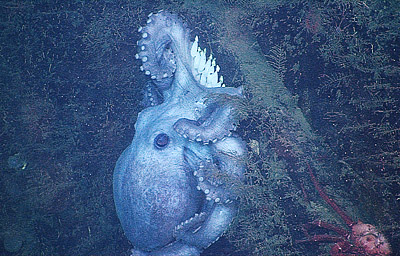
The ultimate goal of all species on the planet is procreation, the act of making anew. And many species go to great lengths to set their progeny off on the right path: orangutan mothers have been known to breast feed for eight years, the father emperor penguin braves the brutal Antarctic winter to warm a single egg, while the mother wolf spider carries her dozens of offspring wherever she goes. However, few could contend with a deep-sea octopus, known as Graneledone boreopacifica, which researchers have recently observed guarding its eggs for four-and-a-half years (53 months), before likely succumbing to starvation soon after.

“At 53 months, it is by far the longest egg-brooding period ever reported for any animal species,” the researchers write in a paper on the discovery published today in the open-access journal PLOS ONE.

In March 2007, the marine biologists, headed by Bruce Robison from the Monterey Bay Aquarium Research Institute, used a remotely-operated vehicle to visit a deep sea site in the Monterey Submarine Canyon off of central California. At 1,397 meters (4,583 feet) deep they came on a female Graneledone boreopacifica protecting a brood of its eggs. A month earlier, when the ROV had visited the same site, the octopus hadn’t been there.

“Given this singular opportunity to measure the length of a brooding period from its inception, we returned to the site 18 times over the ensuing four-and-a-half years,” the scientists write. “Each time we returned we found the same octopus clinging to the vertical rock face, arms curled, covering her eggs. Continuous growth of the eggs provided evidence that it was the same clutch throughout.”

Graneledone boreopacifica mother guarding her eggs. Photo by: 2007 MBARI
The female octopus was also easily identifiable by her tell-tale scars. After 53 months–in the Autumn of 2011–the eggs hatched. When the scientists visited the last time the eggs were empty and the mother was gone, presumably perished.

Many octopus mothers, such as the giant Pacific octopus (Enteroctopus dofleini), are known to lay eggs only once in their lives. They guard and care diligently for the eggs, all the while losing weight and weakening due to a lack of food. They also change color, usually taking on a ghostly pallor. The mothers often die soon after the eggs hatch, essentially sacrificing themselves for the success of their children. The researchers believe Graneledone boreopacifica acts similarly.

The world’s best mother: meet the octopus that guards its eggs for over four years

 
The darkest fabric ever made is now a dress

"There is black, and then there is ultrablack. The shade defined as a black that reflects less than 0.5 percent of the light that hits it, is used on everything from telescopes to cameras. This uniquely dark color is not easy to produce and may appear less black when it is viewed at an angle.

To find a better way to reproduce this cool color, a team at Cornell University looked to nature. Specifically, a bird called the magnificent riflebird."

1764630931173.webp


"Their plumage comes from melanin pigment paired with tightly bunched filaments called barbules that deflect light inward. This combination of pigment barbules means that the feathers absorb nearly all the light that hits it, making the bird look extraordinarily black. However, the feathers are only ultra-back when it is viewed straight on. When looked at from an angle, the plumage appears shiny."
 
IMG_0033.webp


Now Brazilian ornithologists say that they have discovered an analog of the dodo in the remote Amazon: the slaty-masked tinamou, a chickenlike bird that exhibits a total lack of fear toward people. The researchers are looking to the dodo’s demise to prevent the tinamou from suffering a similar fate.

From the New York Times.
New Bird Species
 

New Threads

Top Bottom